

26/11/2025
Electrical Upset Forging Machine Installed Further Increasing Our Manufacturing Capability
Read more
Need a solution?
Please call us now on
+44 (0)1384 563356
Email your enquiry to
sales@brooksforgings.co.uk
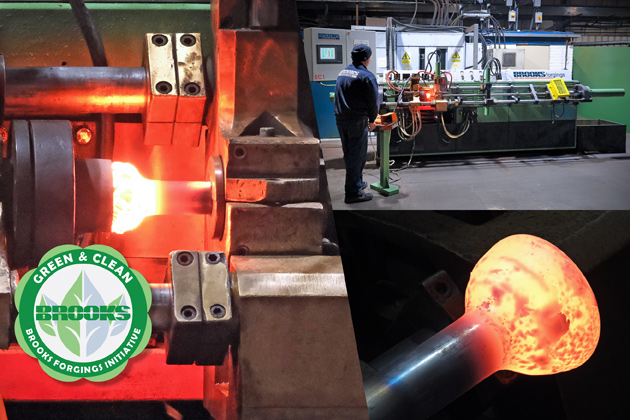
We provide specialist electrical upset forging services, utilising high-precision resistance heating and hydraulic pressure to gather material at the end or mid-section of bars with unmatched volume and control.
By heating only the specific area required for deformation, we achieve massive localised material accumulation on relatively small-diameter bars, creating seamless, high-integrity components that outperform machined or welded alternatives.
We provide specialist electrical upset forging services, utilising high-precision resistance heating and hydraulic pressure to gather material at the end or mid-section of bars with unmatched volume and control. By heating only the specific area required for deformation, we achieve massive localised material accumulation on relatively small-diameter bars, creating seamless, high-integrity components that outperform machined or welded alternatives.
Electrical Upset Forging is a high-precision process that combines electrical resistance heating with hydraulic pressure to gather significant volumes of material, often at a single end of a relatively small-diameter bar.
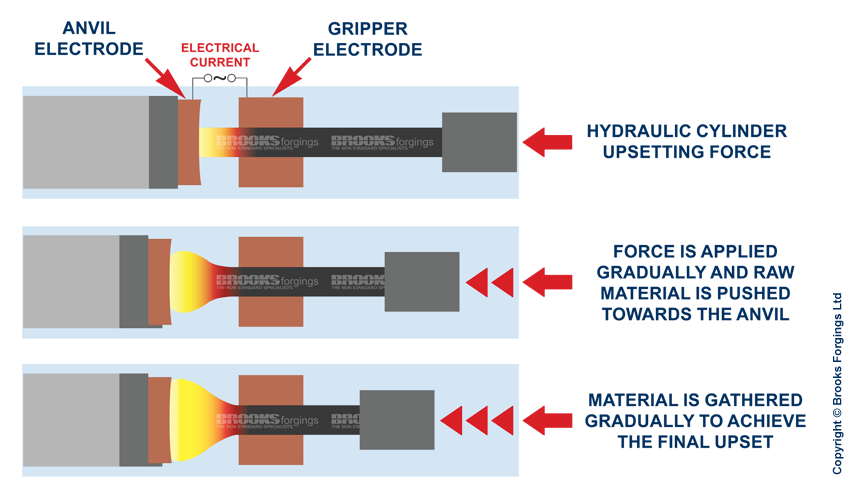
The workpiece is secured within a ‘gripper’ while a hydraulic cylinder applies axial, compressive force. As the bar makes contact with the ‘anvil’, an electrical circuit is completed between the two electrodes.
A high-amperage, low-voltage current passes through the targeted section of the bar. The natural electrical resistance of the metal creates rapid, localised heating, bringing only the required area to the precise forging temperature.
Once at temperature, the bar is driven into the anvil using controlled hydraulic force. This gradually "gathers" the material into the desired form. By precisely manipulating force, anvil position, and travel, we can control the volume and profile of the gather to create complex, bespoke geometries.
This process is highly effective for bars up to 60mm in diameter and is compatible with a wide range of materials, including steel, stainless steel, and various exotic alloys.
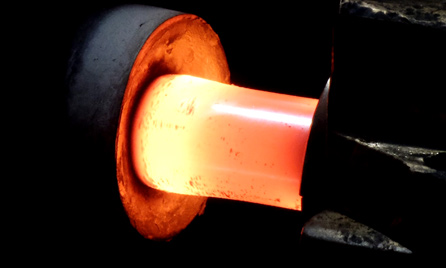
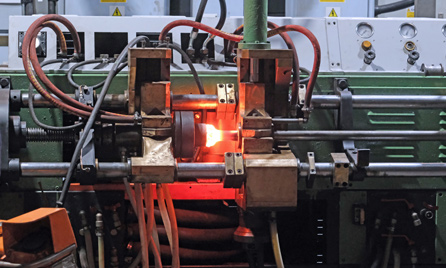
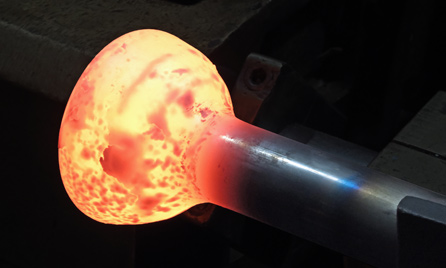
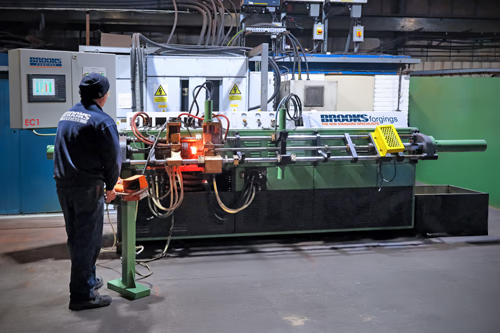
Capable of producing large-diameter flanges and heads on small-diameter bar stock, often achieving ratios far exceeding conventional upsetting.
Because the process maintains the material’s natural grain fibers, you receive a monobloc, one-piece component with strength characteristics superior to machined or welded assemblies.
Unlike batch furnace heating, our electrical resistance method heats only the local area required for deformation, significantly reducing energy consumption and carbon impact.
By forging "near-net" shapes, we minimise burr production and waste, allowing for significant cost savings, especially when working with high-value materials like stainless steel or exotic alloys.
Our ability to produce shapes closely aligned to the final component dimensions reduces the time and cost required for subsequent CNC turning and finishing.
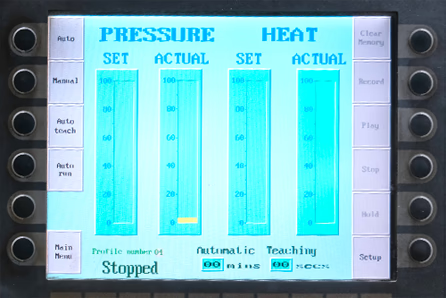
Our electrical upset forging systems feature advanced computer control, allowing us to store and retrieve precise parameters for any component.
By standardising critical variables like heating duration and hydraulic force, this digital library ensures absolute repeatability and consistent structural integrity across every production run.
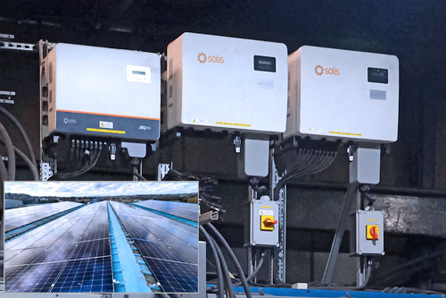
Unlike energy-intensive furnaces, our electrical resistance system consumes power only during the forging cycle, significantly reducing waste.
As part of our "Green and Clean" initiative, we power these cells with on-site solar energy, offering our clients a sustainable, low-carbon solution for their metal forming requirements.
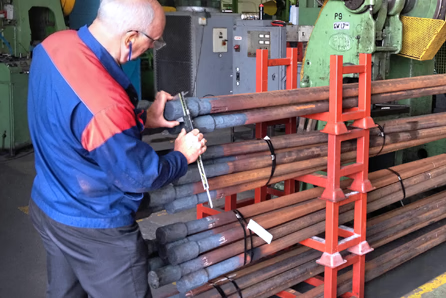
Beyond our automated process control, every component undergoes rigorous verification.
Our quality protocols include stringent dimensional inspection and, where required, destructive testing to ensure material integrity. This commitment ensures our components meet or exceed the demanding performance standards of sectors like aerospace, rail, and heavy industry.

