Need a solution?
Please call us now on
+44 (0)1384 563356
Email your enquiry to
sales@brooksforgings.co.uk
We specialise in high-precision thread rolling, delivering fasteners and components with superior tensile strength, fatigue resistance, and dimensional consistency.
By utilising cold-forming technology to displace rather than remove material, we produce threads that maintain a continuous grain flow, ensuring maximum durability for high-stress industrial applications.
In industrial engineering, the integrity of a threaded fastener is critical. Our thread rolling process reorients the material’s grain structure to follow the profile of the thread, rather than cutting through it. This "work hardening" of the material creates compressive stresses at the root of the thread, which significantly increases resistance to fatigue, shear, and tensile failure compared to traditional cut threads.
Why Choose Brooks for Thread Rolling?
Superior Structural Strength
Cold-forming preserves the natural grain flow of the steel, resulting in threads that are significantly stronger and more durable under load.
Enhanced Fatigue Resistance
The rolling process "burnishes" the thread roots and flanks, eliminating surface imperfections that act as initiation points for fatigue cracks.
Precision & Consistency
Thread rolling provides exceptional dimensional accuracy and repeatability, ensuring a perfect fit across both short-run and high-volume production batches.
Smooth Surface Finish
Our rolled threads offer a significantly lower Ra (roughness average) than cut threads, reducing friction during assembly and improving long-term wear resistance.
Material Efficiency
Because thread rolling displaces material, we require smaller-diameter blanks compared to cutting, reducing material waste and lowering your overall project costs.
Applications & Industries
High-Performance Fasteners
Custom bolts, studs, and tie rods for heavy industrial and structural engineering.
Automotive & Aerospace
Critical components requiring high vibration resistance and longevity.
Foundation & Infrastructure
Specialised threaded rods and anchors where reliability under cyclic loading is mandatory.
Precision Engineering
Components requiring tight tolerances and superior fatigue performance.
The Thread Rolling Process

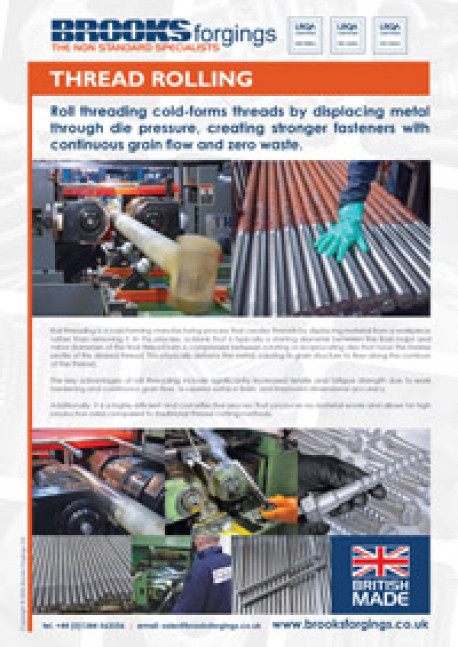
Thread rolling is a precision cold-forming process that creates threads by displacing, rather than removing, material.
The Method
A blank is compressed between rotating or reciprocating dies containing the inverse profile of the desired thread.
Structural Integrity
This physical deformation forces the metal’s grain structure to flow along the contour of the thread, significantly increasing tensile strength and fatigue resistance through work hardening.
Production Efficiency
Unlike thread cutting, rolling is a "chipless" process that creates no material waste, delivers a superior surface finish, and enables high-speed production cycles.
The Thread Rolling Advantage

Thread rolling is a precision cold-forming process that significantly enhances the mechanical properties of a component.
Unlike traditional screw cutting, which severs the material’s natural grain flow (see Figure 1), the rolling process manipulates the metal into continuous, unbroken lines that follow the thread's contour (see Figure 2).
Superior Strength & Integrity
This process creates a "work-hardened" surface, resulting in vastly improved tensile and shear strength.
Because the grain structure remains intact rather than severed, the threads offer superior resistance to 'stripping' and fatigue under load. Any potential failure is forced across the material's diameter, rather than along the path of a cut grain.